
The Wheelhouse · Boat care
Winterizing Your Inboard Boat: A Step-by-Step Guide
A practical winter storage guide. Follow the instructions for your exact boat and engine.
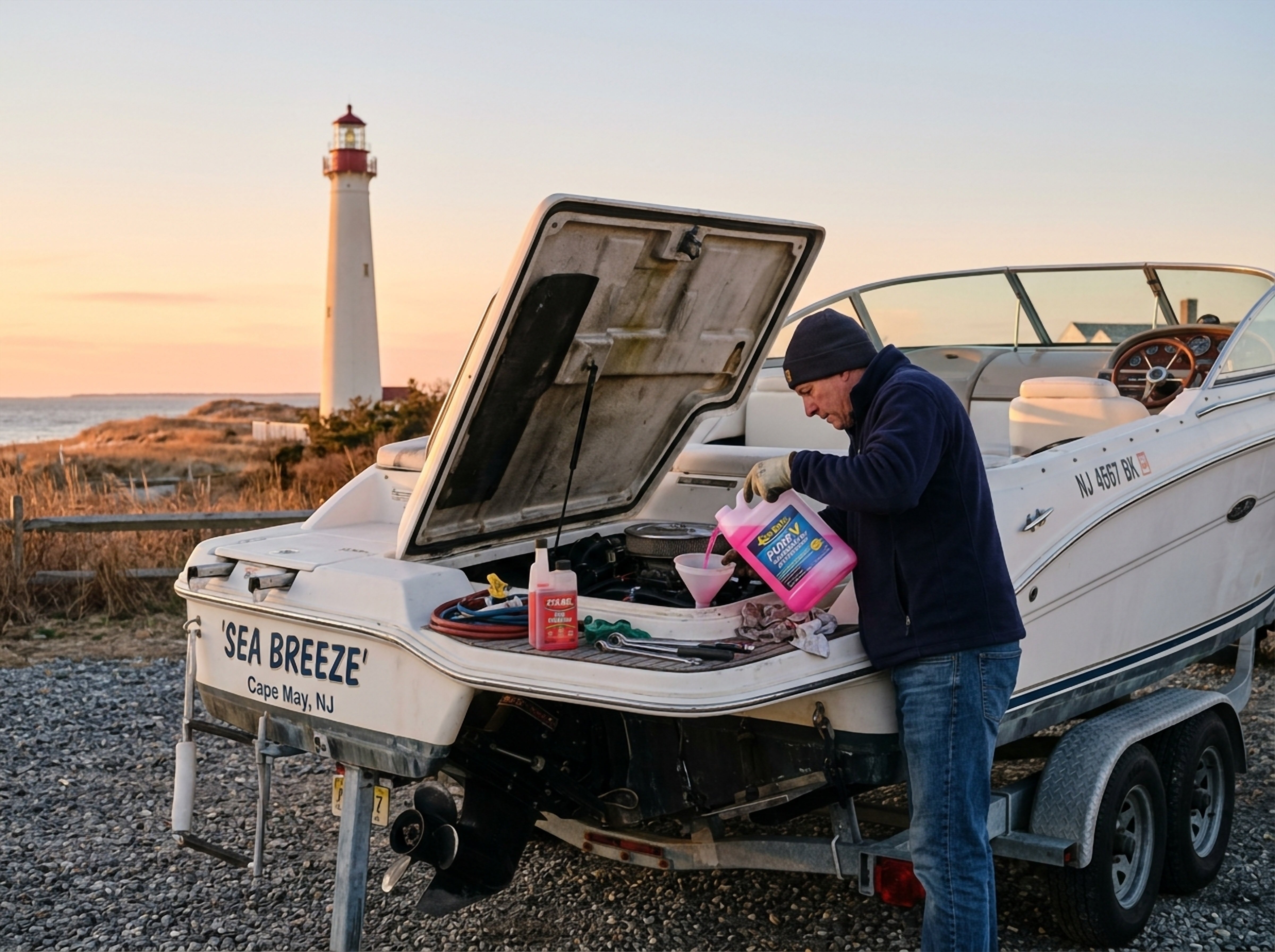
With an inboard there's no drive leg to service - but the whole engine lives inside the hull, so getting the water out of the cooling system matters more than anything else. Here's how to protect it before the first hard freeze.
Plan before freezing weather. Finalize winterization before 32°F enters the 5-day forecast. Check the National Weather Service forecast.
Your engine, boat, battery and equipment manuals take priority over this general guide.
Shop winterization gearBEFORE YOU START
- Read your owner's manual. It shows where the block and manifold drains are and how your cooling system is laid out.
- Decide where the boat will spend the winter - on land or in the water. A few steps differ (see Step 10).
- What you'll typically need: fuel stabilizer, engine oil and filter, fuel filter / water separator, fogging oil (gasoline engines), a stiff wire for drain holes, coolant hydrometer, non-toxic (pink, propylene glycol) antifreeze, marine grease, a moisture-displacing spray, battery charger/maintainer, a moisture absorber, and a cover.
STEP 1 - Stabilize the fuel
Fuel left sitting for months breaks down, and ethanol blends pull in moisture.
- Gasoline: fill the tank to about 95% (not empty - an empty tank collects condensation; not 100% - fuel needs room to expand). Diesel: keep the tank full.
- Add fuel stabilizer at the dose on the bottle.
- Run the engine for several minutes (with cooling water supplied) so treated fuel reaches the lines and injectors or carburetor.
- Replace the fuel filters and fuel/water separator.
STEP 2 - Change the oil and filter
Used oil holds acids and moisture that sit against bearings all winter. Fresh oil stores clean.
- Run the engine briefly first so the oil is warm, drains easily and carries contaminants out.
- Change the oil and filter(s), then check the new filter for leaks.
STEP 3 - Protect the cooling system (the most important step)
Raw-water cooled engines pump in the water they float in. Whatever stays in the block and manifolds expands as it freezes and can split the casting.
(raw-water side - every inboard has one):
- Either drain it completely: open every drain plug or petcock on the block and exhaust manifolds and push a stiff wire into each hole - rust flakes clog them and trap water behind.
- Or circulate non-toxic propylene glycol antifreeze through the raw-water system per your manual until it comes out the exhaust. Make sure the thermostat is open so antifreeze reaches every part of the system, not just the parts upstream of where you added it.
(freshwater/closed-cooled engines):
- Check the coolant with a hydrometer and keep it at a 50/50 mix. Replace rusty or dirty coolant. (Mixes stronger than 50% can actually gel in the cold.)
Pro tip: If you flush with fresh water first (especially after salt or brackish water), do it before draining or adding antifreeze.
STEP 4 - Fog the engine (gasoline only)
A thin coat of fogging oil protects cylinders from rust while the engine sits.
- After the cooling system is protected, spray fogging oil into each cylinder following your manual.
- Diesel engines don't need fogging.
STEP 5 - Wipe down the engine
Displaces moisture from the outside of the engine and its connections.
- Wipe the engine with a cloth lightly dampened with a moisture-displacing spray.
GOOD TO KNOW: There's no lower unit or drive leg to drain on an inboard - your propeller shaft runs straight from the engine through the hull bottom. Instead, look after the running gear and through-hulls (Step 6).
STEP 6 - Running gear, seacocks and strainers
Shafts, props and through-hull fittings sit in the water all season and collect growth, debris and trapped water.
(stored on land):
- Clean the propeller(s) and shaft(s); check for wrapped fishing line and damage.
- Open the seacocks so they drain, and clean the through-hulls and raw-water strainers.
(stored in the water):
- Close the seacocks.
STEP 7 - Drain the boat's water systems
Livewells, sinks, the head, showers and freshwater tanks freeze just like the engine.
- Drain tanks and the water heater. Run each pump dry for a few seconds.
- Run non-toxic (pink, propylene glycol) antifreeze through freshwater lines by opening each faucet and shower until antifreeze comes out, then add it to the water heater. Never use automotive antifreeze.
- Head: pump out the holding tank at an approved facility, flush several times with fresh water, and add antifreeze to the hoses, tank, macerator and Y-valve per the manufacturer.
- Empty, clean and dry the bilge; spray with a moisture-displacing lubricant. If you can't get every drop out, add a small amount of non-toxic antifreeze.
STEP 8 - Pull the hull drain plug (on land only)
Rain and snowmelt drain away instead of pooling and freezing in the bilge.
- Remove the drain plug when the boat is stored ashore.
Pro tip: Clip the plug to your ignition key or helm so it goes back in before launch.
STEP 9 - Charge and disconnect the battery
Batteries slowly drain even with everything off, and a discharged battery can freeze; a fully charged one holds up far better in the cold.
(on land):
- Fully charge the battery, disconnect the negative cable first, then the positive.
- Ideally, take the battery home and keep it on a smart maintainer somewhere dry.
(in the water): see Step 10 - the battery stays aboard to run the bilge pump.
STEP 10 - If the boat stays in the water
An afloat boat still needs to keep itself dry and ice-free.
- Keep the battery fully charged.
- Test the bilge pumps and make sure the float switches work and aren't blocked.
- Use a bubbler or de-icer to keep ice from forming around the hull.
- Check on the boat regularly, or arrange for marina staff to.
STEP 11 - Clean and dry out the interior
Damp gear under a cover turns into mold and mildew.
- Take life jackets, cushions, towels and lines home, or stand cushions on their sides to air out.
- Inspect and test safety gear (life jackets, fire extinguisher, flares) and electronics; replace anything that isn't working.
- Clean lockers and any fridge or freezer.
- Leave a moisture absorber aboard and add rodent deterrent - mice chew wiring and upholstery.
- Clean the hull, especially the bottom, and wax it. Growth wipes off easily in the fall but dries hard over winter.
STEP 12 - Cover the boat
Snow is heavy. A flat cover collects water, sags and tears.
- Use a fitted storage cover or professional shrink-wrap (better protection than a tarp).
- Prop the cover with a pole or frame so it peaks and sheds snow.
- Make sure it's vented so trapped moisture can escape.
COMMON MISTAKES TO AVOID
- Missing a drain on the block or manifolds, or a drain hole clogged with rust - the #1 cause of cracked engines.
- Antifreeze that doesn't reach the whole cooling system (thermostat closed, antifreeze only added upstream).
- Coolant mixed stronger than 50/50.
- Using automotive (ethylene glycol) antifreeze in water systems - use non-toxic propylene glycol.
- Relying on a heater instead of winterizing. If the power fails, the engine is unprotected, and heaters can be a fire risk.
GOOD TO DO DURING THE OFF-SEASON
- Book service and order parts now - shops are quieter in winter than in spring.
- Schedule any repairs you noticed while winterizing (worn hoses, leaks, shaft or prop damage).
COME SPRING
- Drain plug back in and seacocks set correctly BEFORE the boat touches water.
- Reinstall any engine drain plugs you left out.
- Reconnect the battery (positive first, then negative).
- Check the bilge is dry and the bilge pump works.
Get ready for winter
Find winterization supplies at Sea Gear Marine. For professional engine work, contact a qualified marine technician.
Shop winterization gear